
Use this SOP to identify possible child abuse or neglect, make the required report without delay, and document the child’s condition and the actions taken. Everyone should report suspected child abuse. Mandated reporters must follow the reporting steps below whenever they know or reasonably suspect that a child has been abused or neglected.
📚 Resources Needed
Emergency services (911)
California Department of Education Child Abuse Reporting Guide
Besa Health medical record and approved body map
Camera or approved clinical photography process, when indicated
Contact information for the receiving child protective services or law-enforcement agency
✅ Before You Start
If the child is in immediate danger or needs urgent medical assistance, call 911 first.
A report is based on knowledge or reasonable suspicion; proof or a conclusive finding is not required before reporting.
The mandated reporter’s duty is individual. Do not wait for supervisor approval, and no supervisor or administrator may impede or inhibit the report.
Make the telephone report immediately or as soon as practically possible, then prepare and send the written BCIA/SS 8572 report within 36 hours after receiving the information concerning the incident.
Document only what was observed and what was told to you. Do not add interpretation, assumptions, or personal opinion.
Do not conduct your own investigation or repeatedly question the child.
🚀 Tips & Tricks
Use the child’s exact words and record whether the disclosure was spontaneous or made in response to a specific question.
Use calm, open-ended prompts only when clarification is necessary. Do not lead, pressure, promise secrecy, or ask the child to repeat the account to multiple people.
Keep the child safe and supported while another team member makes calls or obtains forms.
Have the reporter’s name, the child’s name and present location, the nature and extent of injury, evidence of prior abuse, and the basis for suspicion ready before calling.
One sign alone does not prove abuse. Consider the complete history, physical findings, behavior, developmental level, and available clinical information.
A qualified clinician must protect possible forensic evidence. If sexual abuse is suspected, do not perform a genital examination beyond a cursory visual inspection; follow the appropriate forensic referral process.
📘 Instructions
Step 1: Protect The Child And Address Immediate Danger
Stay with the child. Do not leave the child alone while an emergency, safety concern, or reporting response is active.
Call 911 for immediate danger, life-threatening injury, or urgent medical assistance.
Provide care within your role and training. Preserve evidence and avoid unnecessary cleaning, changing of clothing, or examination when sexual abuse or another forensic concern may be present.
Notify the appropriate Besa Health leader for operational support, but do not delay or substitute internal notification for the required external report.
Step 2: Apply The Child Abuse Reporting Act
Everyone should report suspected child abuse.
A mandated reporter who, in a professional capacity or within the scope of employment, knows or reasonably suspects child abuse or neglect must telephone an authorized child protective agency immediately or as soon as practically possible.
The same mandated reporter must prepare and send the written BCIA/SS 8572 report within 36 hours after receiving the information concerning the incident.
Mandated reporters who make a required or authorized report have absolute civil and criminal immunity for making the report, as stated in California Penal Code section 11172.
Failure to make a required report is a misdemeanor punishable by up to six months in county jail, a fine of up to $1,000, or both.
An overall clinical assessment may be needed to reach conclusive findings, but reporting must not be delayed while waiting for proof, testing, or a final diagnosis.
Step 3: Make The Immediate Telephone Report
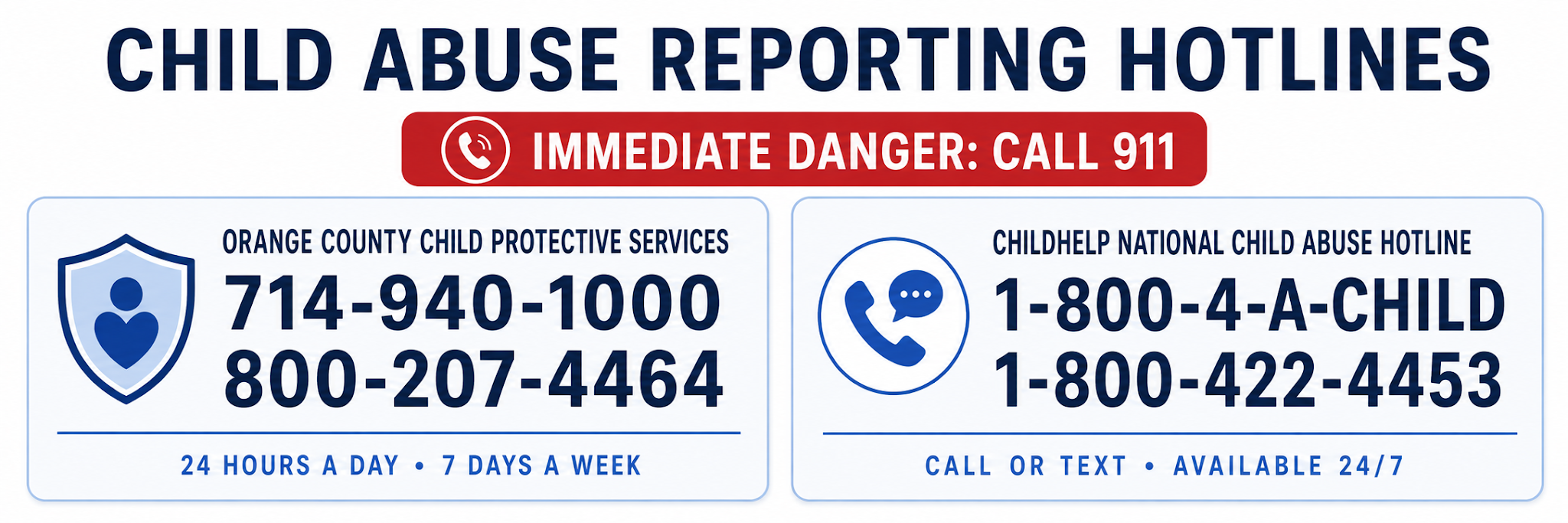
Call Orange County Child Protective Services at 714-940-1000 or 800-207-4464. The hotline operates 24 hours a day, 7 days a week.
If the situation requires another authorized receiving agency, report to the appropriate police department, sheriff’s department, county probation department when designated, or county welfare/child protective services department.
Be prepared to provide:
Your name and role as the reporter
The child’s name and present location
The nature and extent of the injury or condition
Any evidence of prior abuse or neglect
Any other requested information, including what caused you to suspect abuse or neglect
The report must be made even if some information is unavailable. Do not delay while trying to obtain every detail.
Step 4: Complete And Send The Written Report
Open the California Department of Justice BCIA/SS 8572 Form.
Complete the form accurately using observations, the child’s or caregiver’s statements, and the information provided to the receiving agency.
Send the written report to the agency that received the telephone report within 36 hours of receiving the information concerning the incident.
Document the date and time of the verbal report, the date and time the written report was sent, the receiving agency, and the receiving person’s name and badge or identification number when available.
Place any permitted copy or documentation in the medical record according to Besa Health privacy, record-retention, and access requirements.
Step 5: Recognize The Legal Categories Of Child Abuse
Child abuse includes:
A physical injury inflicted on a child by another person by other than accidental means
Sexual abuse, including sexual assault and sexual exploitation
Willful cruelty or unjustifiable punishment of a child
Cruel or inhuman corporal punishment or injury
Neglect, including severe and general neglect
Step 6: Identify Possible Physical Abuse
Physical abuse is any act that results in a nonaccidental physical injury.
Physical indicators may include:
Abrasions, lacerations, or swelling caused by other than accidental means
Burns from cigarettes, rope, scalding water, an iron, a radiator, or another implausible source
Infected burns or other signs of delayed treatment
Belt-buckle marks, handprints, bite marks, or pinches
Patterned bruising, including parallel or circular bruises, or bruises in different stages of discoloration suggesting repeated trauma
Facial injuries such as black eyes, broken jaw, broken nose, bloody nose, or bloody or swollen lips with an implausible or inconsistent explanation
Subdural hematomas, long-bone fractures, or fractures in different stages of healing
A child’s statement that an injury was caused by abuse
An injury unusual for the child’s age or developmental level
A history of prior or recurrent injuries
Unexplained injuries or conflicting explanations
A caretaker’s attempt to hide injuries
Obvious disturbance in the parent-child or caretaker-child interaction
Behavioral indicators may include:
Excessive passivity, compliance, or fearfulness
Hostile, aggressive, or verbally abusive behavior toward others
Fearful or withdrawn behavior
Self-destructive behavior, including self-injury
Destructive behavior, including breaking objects or setting fires
Out-of-control anger, panic, or easy agitation
Fear of going home or of parents/caretakers, or extreme protectiveness of them
Attempts to hide injuries or wearing excessive layers of clothing, especially in hot weather
Difficulty sitting or walking
Clinginess or indiscriminate attachments
Apprehension when other children cry
Wariness of physical contact with adults
Drastic behavioral changes in and out of a parent’s or caretaker’s presence
Seizures or vomiting
Depression, suicide attempts, substance abuse, or sleeping or eating disorders
Step 7: Identify Possible Sexual Abuse
Sexual abuse includes sexual assault and sexual exploitation of a minor.
Physical indicators may include:
The child reports sexual activity or contact
Torn, stained, or bloody underclothing
Trauma, lacerations, irritation, pain, itching, swelling, bruising, bleeding, or abrasions of the anal or genital area, especially when unexplained or inconsistent with the history
Swelling or discharge from the vagina or penis
Visible lesions around the mouth or genitals or a sexually transmitted infection
Lower abdominal pain
Painful urination or defecation
Difficulty walking or sitting because of genital or anal pain
Psychosomatic symptoms such as stomachaches or headaches
Evidence that the child is also experiencing another form of abuse
Behavioral indicators may include:
Sexualized behavior, precocious explicit sexual knowledge, or overt or repetitive sexual behavior involving self or others
Detailed, age-inappropriate understanding of sexual behavior or excessive curiosity about sexual matters or genitalia
Compulsive behavior or indiscreet masturbation
Unusually seductive behavior with classmates, teachers, or other adults
The source protocol lists excessive concern about homosexuality, especially among boys. Sexual orientation itself is not evidence of abuse; document only observable concern or distress and consider it with the full clinical context.
Wetting pants, bedwetting, fecal soiling, or other age-inappropriate regression such as thumb sucking
Eating disturbances, including overeating or undereating
Fears, phobias, fear of a parent/caretaker, or fear of going home
School problems, speech disorder, a significant change in attitude or grades, or inability to concentrate
Drastic behavior changes, withdrawal, clinical depression, apathy, chronic fatigue, or excessive compliance
Poor hygiene or excessive bathing
Poor peer relationships or social skills, inability to make friends, or withdrawal from sports and social activities
Acting out, running away, aggression, antisocial behavior, or delinquent behavior
Alcohol or drug abuse
Commercial sexual exploitation or prostitution, or markedly age-inappropriate sexual behavior described in the source protocol as excessive promiscuity
Suicide attempt, self-mutilation, or other self-destructive behavior
Step 8: Identify Possible Neglect
Neglect is negligent treatment or maltreatment of a child by a parent or caretaker under circumstances indicating harm or threatened harm to the child’s health or welfare.
Physical indicators may include:
Lack of adequate medical or dental care
Persistent sleepiness or hunger
Persistent dirtiness, extremely offensive body odor, or clothing inadequate for the weather
Evidence of poor supervision
Extremely or persistently unsafe or unsanitary home conditions
Signs of malnutrition or a poorly balanced diet, including a bloated stomach, extreme thinness, dry or flaking skin, pallor, or fainting
Emotional neglect or failure to thrive, including failure to gain weight at the expected rate for a typical child
Behavioral indicators may include:
Clinginess or indiscriminate attachment
Depression, withdrawal, or apathy
Antisocial or destructive behavior
Fearfulness
Substance abuse
Speech, eating, or habit disorders such as biting, rocking, or whining
Frequent sleepiness or hunger
Bringing only candy, chips, and soda for lunch or consistently “forgetting” to bring food
Step 9: Document The History
Record what the child said in the child’s own words and whether the disclosure was spontaneous or made in response to a specific question.
Interview parent(s) or caretaker(s) separately when clinically appropriate and record their explanations, including any discrepancies in the history.
Record what happened, when it happened, where it happened, how it happened, and whether there were witnesses.
Record who lives with the child and who provides care.
Record prior injuries, hospitalizations, and emergency department visits.
Record medical conditions that may mimic an abuse pattern.
Do not change the child’s words, add interpretation, or state an opinion as fact.
Step 10: Document Physical And Emotional Findings
Record the child’s physical and emotional state at the time of disclosure or examination.
Record hygiene and the condition and appropriateness of clothing.
A qualified clinician should complete a physical examination when indicated, including growth measurements and observation of all skin surfaces, scalp, groin, oral cavity, and fundoscopic examination, with detailed documentation of suspicious findings.
If sexual abuse is suspected, do not perform a genital examination beyond a cursory visual inspection because additional examination may compromise later forensic evidence collection. Arrange the appropriate forensic evaluation.
Take clinical photographs when permitted and helpful, following consent, privacy, evidence-handling, and Besa Health documentation requirements.
Use an approved body map and applicable evidence-documentation instructions when photographs are not available or as an additional record.
Step 11: Document Laboratory And Radiology Evaluation
Record every laboratory and radiological test ordered and its result when available.
The qualified clinician should consider:
An ophthalmology examination for a child younger than 3 years
A skeletal survey for a child younger than 2 years
A CT scan for a child younger than 6 months
Use clinical judgment and applicable specialty or emergency guidance; reporting must not wait for testing.
Step 12: Document The Assessment
Document the clinical reasoning for why an injury or condition appears nonaccidental.
Do not place “r/o” before an abuse diagnosis because it may be interpreted as meaning the diagnosis has been ruled out.
Distinguish direct observations, exact statements, test results, and clinical assessment.
Step 13: Document The Plan And Follow-Up
Document who made the verbal report and the written report, when each report was made, to whom each was made, and the name and badge or identification number of the child protective services or law-enforcement representative.
Document referrals for other services, including counseling when appropriate.
Document information and medical-care instructions provided to the nonabusive parent or caretaker.
Document the child’s disposition.
Schedule and document a follow-up appointment when clinically appropriate.
Maintain confidentiality and share information only as permitted or required for reporting, treatment, and safety.
🛠 Troubleshooting
The Child Is In Immediate Danger
Call 911, stay with the child, provide care within your role, and then complete the required child-abuse report. Do not leave the child alone.
You Are Unsure Whether The Information Meets The Threshold
Reasonable suspicion does not require certainty or proof. Make the report to the authorized agency and provide the facts you observed or received. Do not investigate on your own.
A Supervisor Is Unavailable Or Disagrees
The reporting duty is individual. Make the report immediately or as soon as practically possible. Internal review must not delay, impede, or replace the report.
Another Person Says They Already Reported
Unless an authorized joint-reporting process clearly includes you and satisfies the law, do not assume another person’s report ends your individual duty. Confirm the authorized process or make the report yourself without delay.
The Child Begins To Disclose Abuse
Stay calm, listen, use the child’s exact words, avoid leading questions, do not promise secrecy, and explain that you need to involve people who can help keep the child safe.
Possible Sexual Abuse Requires Examination
Limit examination to what is medically necessary and within scope. Do not perform a genital examination beyond a cursory visual inspection. Protect forensic evidence and arrange the appropriate specialized evaluation.
The Form Or Website Is Unavailable
Make the telephone report on time. Obtain the BCIA/SS 8572 form from the receiving agency or the California Department of Justice Child Abuse Forms page and send it within 36 hours.
Some Reporter Or Child Information Is Unknown
Report what is known. Tell the receiving agency which information is unavailable and document that fact; do not delay the report.
✅ Completion Check
The child’s immediate safety and urgent medical needs were addressed.
The child was not left alone during an active emergency or safety response.
The telephone report was made immediately or as soon as practically possible to an authorized agency.
The written BCIA/SS 8572 report was sent to the receiving agency within 36 hours.
The reporter recorded the child’s own words, direct observations, and factual information without adding interpretation or opinion.
All applicable physical-abuse, sexual-abuse, and neglect indicators were considered and documented.
The history, physical and emotional findings, tests, assessment, report details, referrals, instructions, disposition, and follow-up were documented as applicable.
The receiving agency, receiving person, badge or identification number, and the dates and times of verbal and written reports were documented when available.
Confidentiality, evidence preservation, and record-handling requirements were followed.
References
Forms: BCIA/SS 8572 Report Form • DOJ Child Abuse Forms
Guidance: CDE Child Abuse Reporting Guide • Orange County Child Abuse Reporting • Childhelp National Child Abuse Hotline
Law: California Penal Code § 11166 • California Penal Code § 11172
Source: CalOptima Provider FSR/MRR Binder, pages 93–97 • Rev. Jun 15, 2020
Comments (0)