Obtain and record height and weight at every visit in the vital signs section.
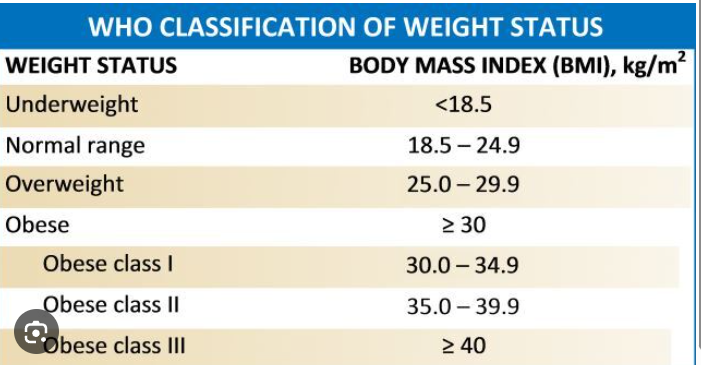
Calculate and document BMI.
Exception: If the patient screens positive for an eating disorder or has a prior diagnosis of an eating disorder, do not ask about height/weight at every visit.
Has the patient had an Annual Wellness Exam (AWE) in the last 12 months?
Has labwork (CBC, CMP, lipids, A1c, TSH) been completed in the last 6 months?
Personal/family history of medullary thyroid cancer or MEN 2? (GLP-1 contraindication)
History of pancreatitis? (GLP-1 caution)
Female patients: Menstrual history.
Goals: Patient’s specific weight loss goals.
General Medical History: PMH, PSH, FMH, SocHx, current medications, drug allergies, chronic conditions.
🎯 Plan
Schedule a second visit as a video annual wellness visit if the patient has not had an annual physical in the last 12 months.
Review and update medical history during the annual wellness visit.
🔁 Follow-Up Structure
First Follow-Up (1-Month)
Assess for early changes (energy, clothing fit) even if weight is unchanged.
Review adherence to nutrition and activity plans.
Address barriers and reinforce motivation.
Recurrent Follow-Ups
Every 1 month for new medication changes or active titration.
Every 3 months for stable patients.
At Each Follow-Up
HPI:
Starting BMI (with date)
Current BMI
Current nutrition plan
Current exercise plan
Medication Review:
Current medication plan
Duration/efficacy
Side effects
Behavioral Health:
Therapist involvement (if any)
Registered dietician involvement (if any)
Adjust plan as needed based on progress, side effects, and patient feedback.
➤ Referral Out
Eating Disorders:
Patients who screen positive for a possible eating disorder should be referred out for specialized care (self-referral to an eating disorder center or psychiatrist).
Unstable Mental Health:
Patients with unstable mental health should have these needs addressed first. This may be managed at Circle Medical or referred to psychiatry if the mental health needs are complex.
Active Substance Abuse:
Patients with active substance abuse (e.g., alcoholism) should address substance use first before initiating a weight loss program.
🔢 Overweight and Obesity Coding (E66)
Begin with coding the complications (rather than a body mass index code), such as obesity complicating pregnancy, childbirth, and the puerperium, if applicable (O99.21-).
Do not use E66.0 (Obesity due to excess calories) as it is a non-billable code.
Use the following codes as appropriate:
E66.01 Morbid (severe) obesity due to excess calories
E66.09 Other obesity due to excess calories
E66.1 Drug-induced obesity
E66.2 Morbid (severe) obesity with alveolar hypoventilation
E66.3 Overweight
E66.8 Other obesity
E66.9 Obesity, unspecified
Add any other health conditions impacted by obesity, such as:
I10 – Hypertension
R73.9 – Hyperglycemia
E11.x – Type 2 diabetes
R73.09 – Prediabetes
E88.81 – Metabolic syndrome
G47.x – Sleep apnea
E78.5 – Hyperlipidemia
K76.0 – NAFLD
M17.9 – Osteoarthritis of knees (weight-bearing joints)
✨ Special Considerations
GLP-1 Agonists: Contraindicated in patients with personal/family history of medullary thyroid cancer or MEN 2. Use caution in patients with history of pancreatitis.
Eating Disorders: Avoid routine weight checks; focus on behavioral and psychological support.
Lab Monitoring: Repeat labs as clinically indicated, especially with medication changes.

Comments (0)