
📚Definitions
- Temporary Bridge Patient: A patient new to the platform or requiring a short-term refill to bridge care until further evaluation or transfer of care.
- Established/Recurring Patient: A patient with an ongoing relationship on the platform, with documented follow-up and stable management of chronic conditions.
- Stable Chronic Condition: A chronic disease state (e.g., hyperlipidemia, hypertension, asthma) with documented control and no recent exacerbations or medication changes.
🗺️ Overview
This policy outlines the criteria and workflow for medication refills provided through the telemedicine platform. The goal is to ensure continuity of care, patient safety, and regulatory compliance, while allowing provider discretion based on individual patient needs. This policy applies to all providers delivering care via the telemedicine platform, with a focus on common chronic conditions such as hyperlipidemia, hypertension, and asthma, etc.
🔁 Refill Supply Guidelines
-
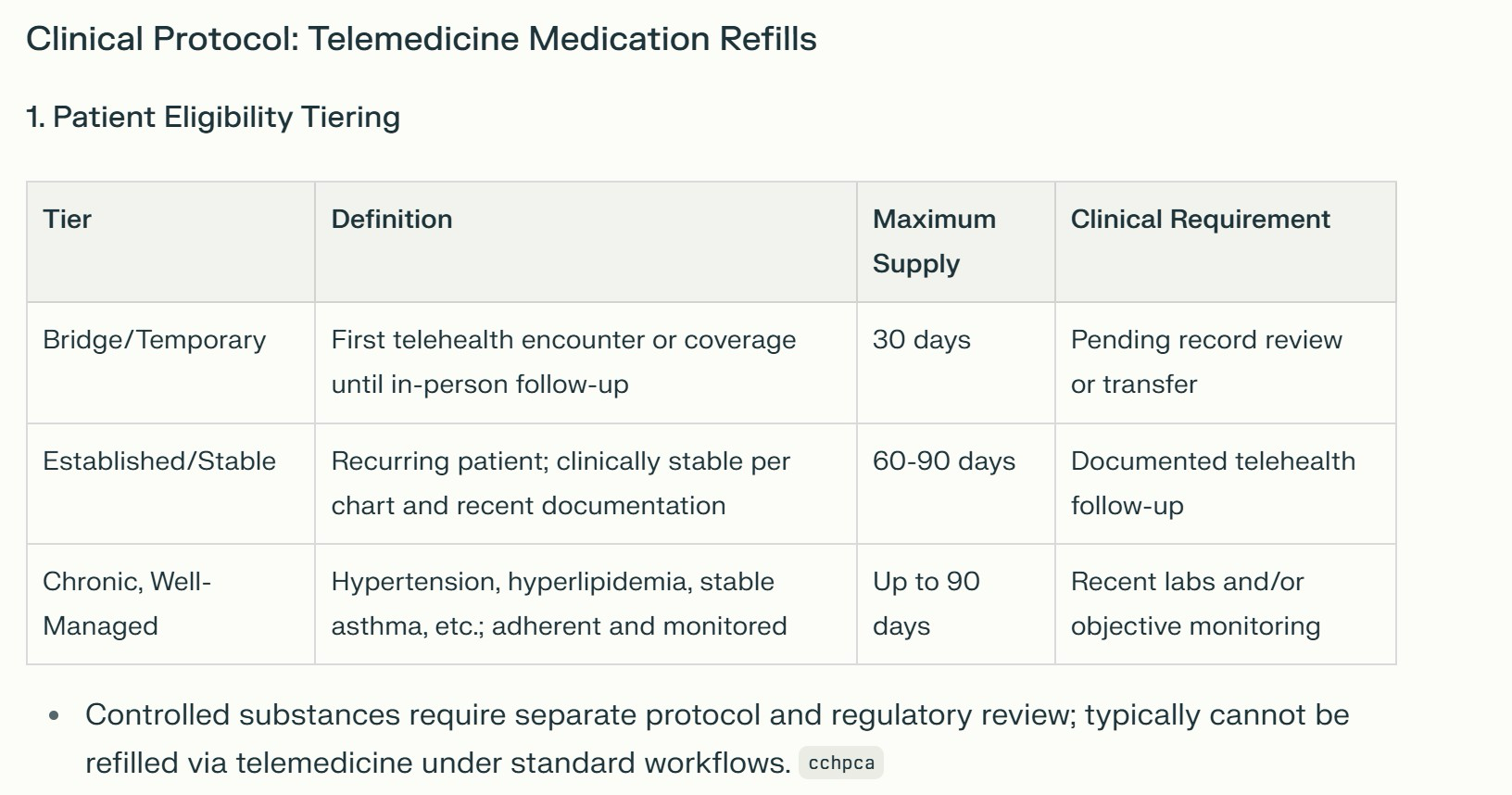
Temporary Bridge Refills (New Patients):
- Maximum Supply: 30 days
-
Criteria
- Awaiting transfer of records or confirmation of diagnosis.
- Pending in-person evaluation or specialist follow-up.
-
Provider Actions
- Review available medical history and medication list.
- Assess for contraindications, drug interactions, and recent labs (if available).
- Document rationale for bridge refill.
-
Established/Recurring Patients
- Standard Supply: 60 days
- Extended Supply: Up to 90 days for stable chronic conditions, at provider discretion.
-
Criteria
- Documented diagnosis and ongoing management.
- Documented diagnosis and ongoing management.
- Demonstrated medication adherence and stability.
- At least one telemedicine visit within the past 6 months.
- Review of recent labs or clinical data as appropriate.
-
Provider Actions:
- Confirm clinical stability and absence of adverse effects.
-
Document rationale for refill duration.
-
Provider Discretion
-
Providers may adjust refill duration based on:
- Clinical stability or instability.
- Recent therapy changes.
- Adherence concerns.
- Monitoring needs.
- Regulatory or insurance requirements
-
All deviations from standard supply must be documented with clinical justification.
-
Providers may adjust refill duration based on:
-
Exclusions
- Controlled substances and medications with high abuse potential are not eligible for refill on telemedicine.
-
Acute medications (e.g., antibiotics, short-term steroids) are excluded from this protocol.
🎯 Workflow (Patient on Member Plan)
-
Refill Request Received
- Patient submits refill request via telemedicine platform.
-
Patient Status Assessment
- Determine if patient is a Temporary Bridge or Established/Recurring patient.
-
Clinical Review
- Review patient’s medical history, medication list, recent labs, and clinical data.
- Assess for stability of chronic conditions (if applicable).
-
Refill Authorization
- Temporary Bridge: Approve up to 30-day supply if criteria met.
- Established/Recurring: Approve up to 60-day supply; consider up to 90-day supply for stable chronic conditions.
- Adjust supply as clinically indicated, documenting rationale.
-
Documentation
-
Record
- Patient status (Temporary Bridge or Established/Recurring)
- Medication(s) refilled and supply duration
- Clinical data reviewed
- Rationale for refill duration
- Follow-up or monitoring plan
-
Record
-
Communication
- Notify patient of refill approval and any follow-up requirements. (Order creation)
-
Schedule follow-up telemedicine or in-person visit as appropriate.
🔍 Monitoring and Quality Assurance
- Periodic review of refill practices for compliance with policy.
-
Ongoing provider education regarding safe prescribing and documentation standards.
📍 Specific Conditions Medications
-
Hypertension:
Annual in-person or telehealth visit with BP log
Renal function/electrolyte panel within last 12 months for ACE inhibitors or other renally-acting drugs
Hypertension (HTN): Blood pressure at goal based on patient-reported home logs or last in-person measurement (within last 3-6 months). No reports of hypotension or significant side effects.
-
Hyperlipidemia:
Lipid panel within previous 12 months for statins/fibrates
Hyperlipidemia (HLD): Patient at goal LDL-C based on latest labs (within last 6-12 months). No recent adverse effects reported.
-
Asthma:
- Annual assessment for control/exacerbations; restrict to 30 days if increased rescue medication use or recent exacerbation
- Patient reports good control (e.g., using rescue inhaler < 2x/week, no nighttime symptoms, no recent exacerbations or oral steroid use). Review of Asthma Action Plan is encouraged.
Depression & Anxiety Disorders Refill Protocol
-
Medication Supply
- Initial or new patients: up to 30-day supply.
- Established patients with stable symptoms and documented adherence: up to 60-90 days at provider discretion.
-
Monitoring Requirements
- Recent mental health assessment within 3-6 months.
- Evaluation of symptom stability and side effects (e.g., mood changes, suicidality, sedation).
- Documentation of medication adherence and tolerability.
-
Provider Discretion
- Limit refill duration if new or worsening symptoms, adverse effects, or lack of follow-up.
-
Extend supply for stable patients with reliable follow-up plans and adherence.
Hypothyroidism Refill Protocol Medication Supply
Full replacement prescription typically up to 90 days for established, stable patients.
-
Monitoring Requirements
- Recent TSH lab within last 6-12 months or clinical indication for earlier testing.
- Confirm dose stability and no new symptoms of hypo- or hyperthyroidism.
-
Provider Discretion
- Shorten supply if labs or clinical status unclear or dose changes suspected.
- Extend supply if doses stable and labs within target range.
GERD Refill Protocol Medication Supply
- Initial or new patients: up to 30 days supply.
-
Established patients with symptom control: up to 90 days supply at provider discretion.
-
Monitoring Requirements
- Clinical assessment of symptom control and medication side effects.
- Periodic evaluation for complications or alarm symptoms (weight loss, dysphagia).
-
Provider Discretion
- Limit supply if persistent symptoms or alarm features.
-
Longer supply for well-controlled symptoms, no complications, and adherence.
Diabetes Medication Refill Protocol for Providers Patient Eligibility & Refill Supply
-
Bridge/Temporary Patients:
- Maximum 30-day supply for initial or unestablished patients until comprehensive assessment is done.
-
Established, Stable Patients:
- Refill length up to 60 days for patients with documented stable glycemic control and recent labs.
-
Consider up to 90-day supply for stable patients with no recent hypoglycemia, consistent monitoring, and adherence, at provider discretion.
🩺 Clinical Assessment & Monitoring
- Confirm patient has had a recent (within last 3–6 months) HbA1c test demonstrating stable or improved control.
- Verify self-monitoring blood glucose (SMBG) logs or continuous glucose monitor (CGM) reports as applicable, showing stable glycemic trends without frequent hypoglycemia or hyperglycemia episodes.
- Evaluate medication adherence and side effects (hypoglycemia symptoms, GI side effects if on metformin or GLP-1 receptor agonists).
- Review renal function and liver function tests within the last 12 months for medications requiring such monitoring (e.g., metformin contraindications, SGLT2 inhibitors).
Provider Discretion Points (Diabetes - Specific)
-
Limit refill supply or require earlier follow-up if:
- HbA1c is significantly elevated or worsening.
- Patient reports frequent hypoglycemia or adverse effects.
- Recent hospitalization for diabetes-related complications.
- Inadequate objective monitoring data (e.g., lack of SMBG or CGM logs).
-
Providers may extend refill up to 90 days if:
- Patient demonstrates stable control with good adherence and low adverse event risk.
- Limited access to in-person care or pharmacy (e.g., rural setting).
- Recent comprehensive diabetes management plan is documented.
Provider Discretion Decision Points (Generalized)
-
Providers may override tiered supply limits (up to 90 days) IF:
- Clinical documentation supports stability and safety.
- Objective monitoring is present (e.g., home BP logs for hypertension, recent lipid labs for statin therapy, asthma control/severity documented in visits).
- There is limited access or hardship (rural, laborious pharmacy travel).
-
Providers may restrict supply if:
- Labs overdue, poor control, adverse effects, or safety risk.
- No recent clinician assessment or unresolved medication queries.
-
Factors Warranting a Shorter Supply (< 60 days):
- Need for Close Monitoring: Titrating doses, introducing a new medication, or monitoring for side effects.
- Unstable Condition: Patient reports new or worsening symptoms (e.g., elevated BP readings, increased shortness of breath in asthma).
- Non-Adherence Concerns: Evidence of medication misuse or failure to follow the treatment plan.
-
Pending Diagnostics/Labs: Awaiting results that may alter therapy.
Documentation Requirement: Any deviation from the standard refill protocol must be clearly documented in the patient's clinical note with a brief rationale (e.g., "Prescribing 30-day supply to re-check lipids in 4 weeks due to recent statin dose increase.")
If you have any questions or would like more information, please reach out to the Delegating Physician.
Comments (0)